
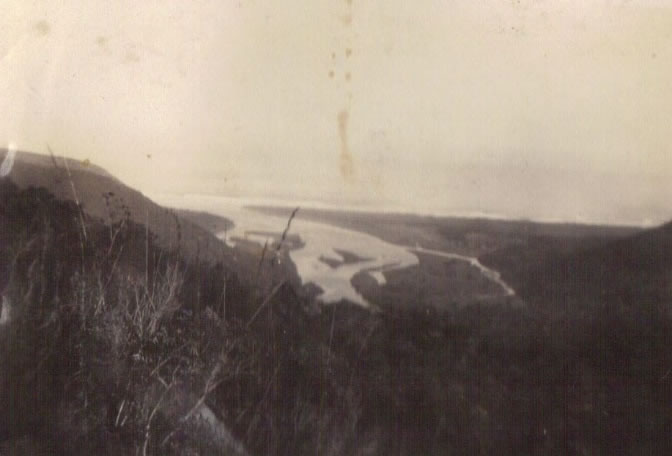
Piesang Valley in 1930
After researching several historic publications, which will be mentioned and even shown as proof of the following review… and interviewing a few of the remarkable historians of our town including the Harker, Muller and Monk families as well as Monica Raubenheimer, made me realize what an important role Piesang Valley actually plays in the rich history of our town.
In 1630, the Portuguese “Sao Concalo” ship which got shipwrecked at Robberg in March that year, had been anchored at the mouth of the Piesang River, according to the “Sao Concalo” article in the Sunday Times of 22 June 1924. This shows us that Piesang Valley is mentioned at early as the early 17th century, even before our town had its name.

Piesang Valley in 2015 – 85 years later but still beautiful
Then in 1850, the very first church in the entire Plett, Knysna and George Anglican district was built here in Piesang Valley, and I will share more of the details.
Then in 1980, the Plett Publicity Association declared this little church in Piesang Valley one of the 7 most historic places in our town.
Don’t these few facts already prove to us the significance of Piesang Valley in the development of our town’s history?
My grandmother Bertha Dunn, born on 1st of June 1905 took this pic of Piesang Valley in 1930 from the side of what we now know as “Schoongezicht.”
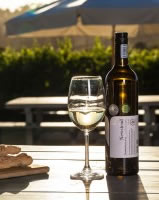
This pic I’ve taken a month ago from Schoongezicht. And it shows how beautiful Piesang Valley still is today, even amidst all the development.
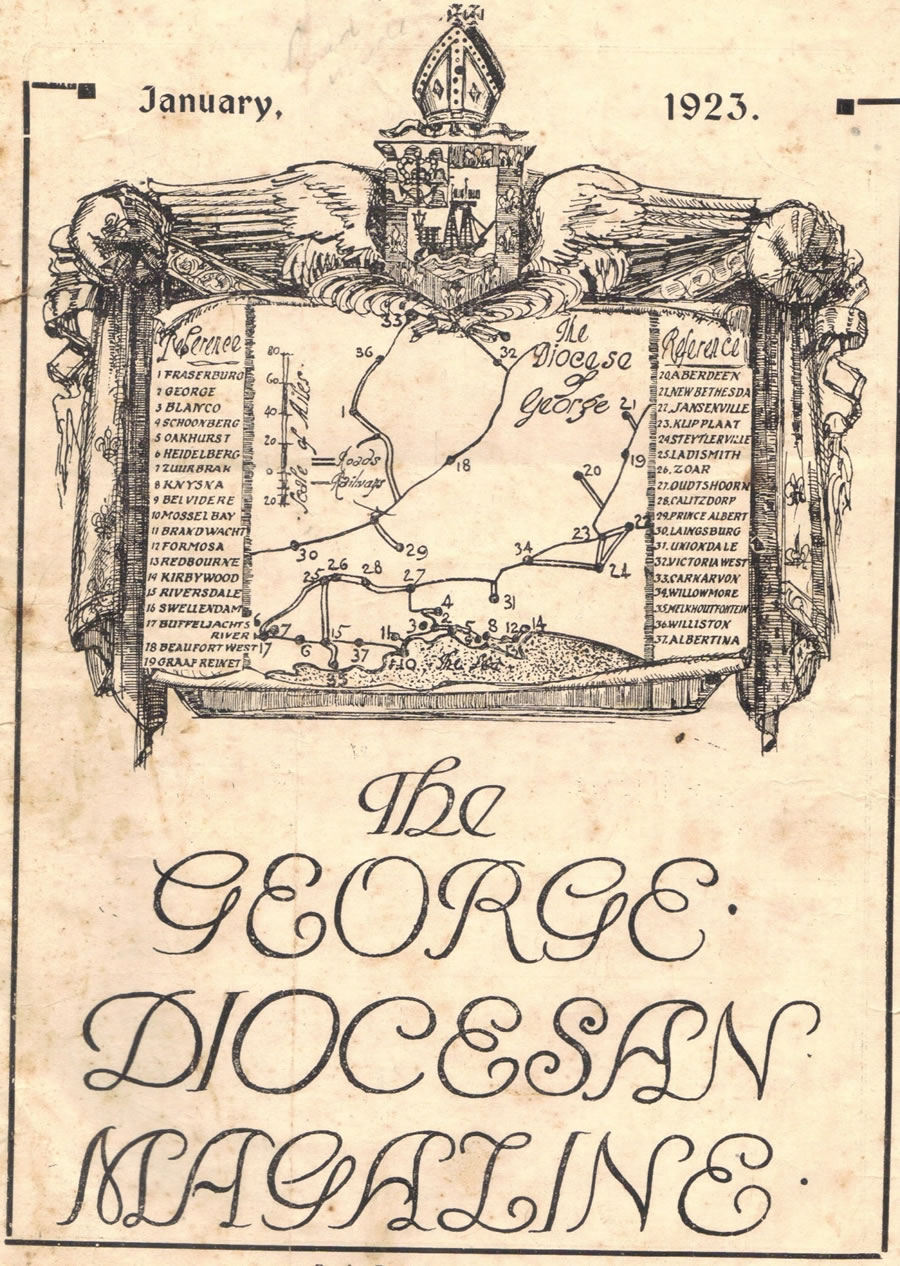
The George Diocesan Magazine of January 1923
The George Diocesan Magazine of January 1923, belonging to my grandmother, in which I’ve received my info on the little church in Piesang Valley
The printed pamphlet of the 1850 historic church in Redbourne, Piesang Valley, which was declared a historic site
The Plett Publicity Association bulletin in which the most historic sites in our town were declared in 1980
According to Patricia Storrar, page 23 of her book “Portrait of Plettenberg Bay”, ships came all the way up the Piesang River from the earliest times, even before the establishment of Plettenberg Bay, which proves that Piesang Valley area developed before the Plett CBD area developed, and there were many people and many labourers living in Piesang Valley where the first church and later schools were built, to provide in the spiritual and educational needs of the inhabitants.
In 1824 William Newdigate was born in Plett, where his grandfather owned 5 farms in the area. The Newdigates owned Buccleuch, Redbourne, Ladywood, Astley (which forms part of New Horizons and Weldon Kaya) as well as Jackalskraal near Kranshoek.
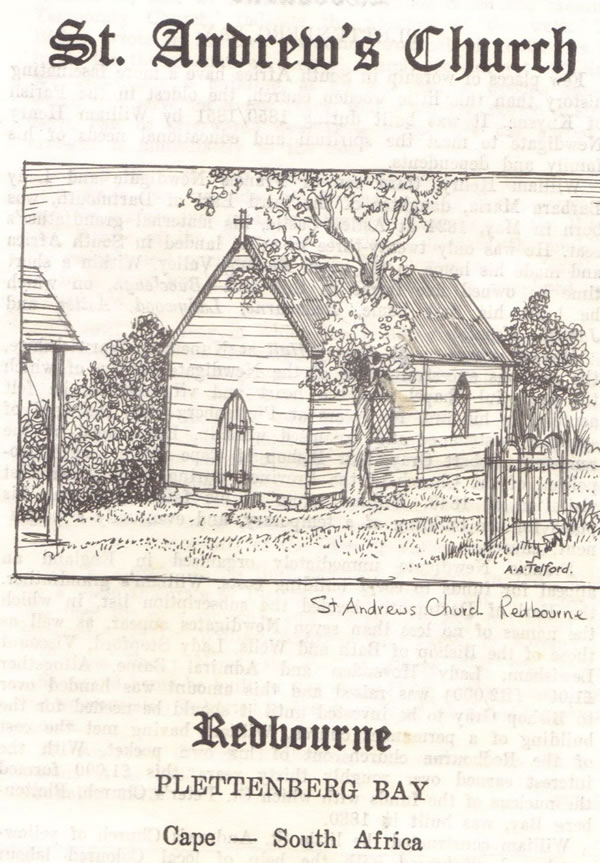
The printed pamphlet of the 1850 historic church in Redbourne, Piesang Valley
William Newdigate and his family lived in Piesang Valley. He then realized the need to be enriched spiritually as well as educationally, so his first attempt was the building of the yellowwood chapel called Saint Andrews church in Rebourne, Piesang Valley, in 1850, to serve their family and their labourers who were mostly coloured. The church served a total of 17 people at that time.
The closest schools in the area were the one in Wittedrift where Mr Lindenberg was the headmaster – this school which later evolved to what we know as Plett Primary now, and the other school was the Saint Peter’s Mission school at the Old Rectory in Bull Street near Hobie Beach which my grandfather Michael William Dunn started in 1912.
So therefore a definite need arose for the building of schools in Piesang Valley, where a great percentage of the Plett community lived at that moment.
Three schools were then built in Piesang Valley, namely:
- The school at “One Plett”,
- The school at Redbourne, and
- The NG Sending School in Piesang Valley.
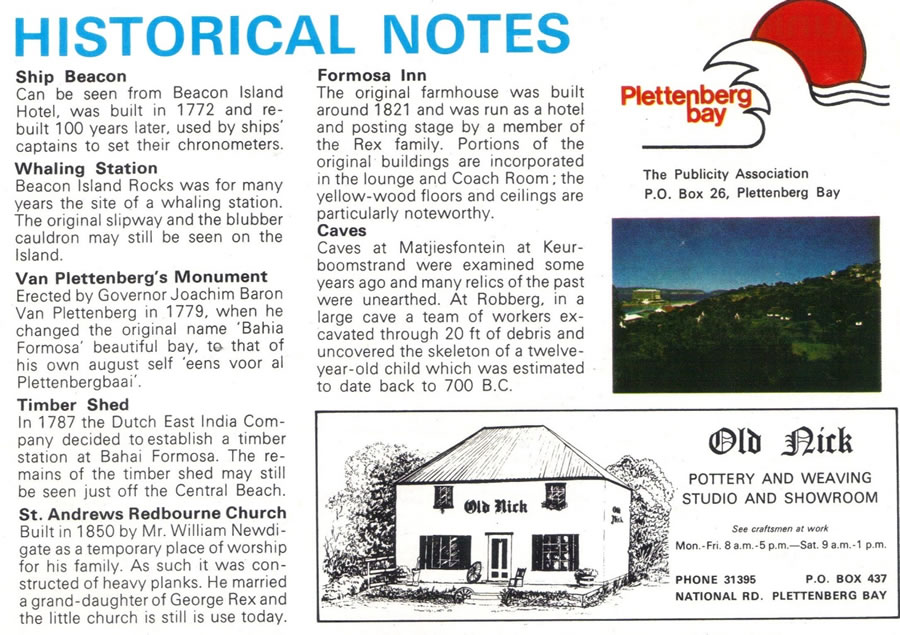
The Plett Publicity Association bulletin 1980
The school at “One Plett” and Heilbron Farm was the first school to be built in Piesang Valley. This school was built on a dairy farm, seeing that there was a huge dairy farm which stretched all the way from Weldon Kaya down to Heilbron farm. Mr Le Roux started the school at “One Plett”. It was a primary school, built in the early 20th century, and served mostly white English speaking students.
The original owner of the dairy farm was Admiral Stuart. It was then sold to Sister Evans, and then later to Ben Roos, who then eventually changed the name to Heilbron Farm. Mr Le Roux run what we call a “one man school”. He was the headmaster and he also taught all the classes. His assistant was Miss Talliard. When this little school eventually closed down, Mr Le Roux moved to the Plett Primary school building which was then erected opposite the Seaview Store, where Cornuti is now.
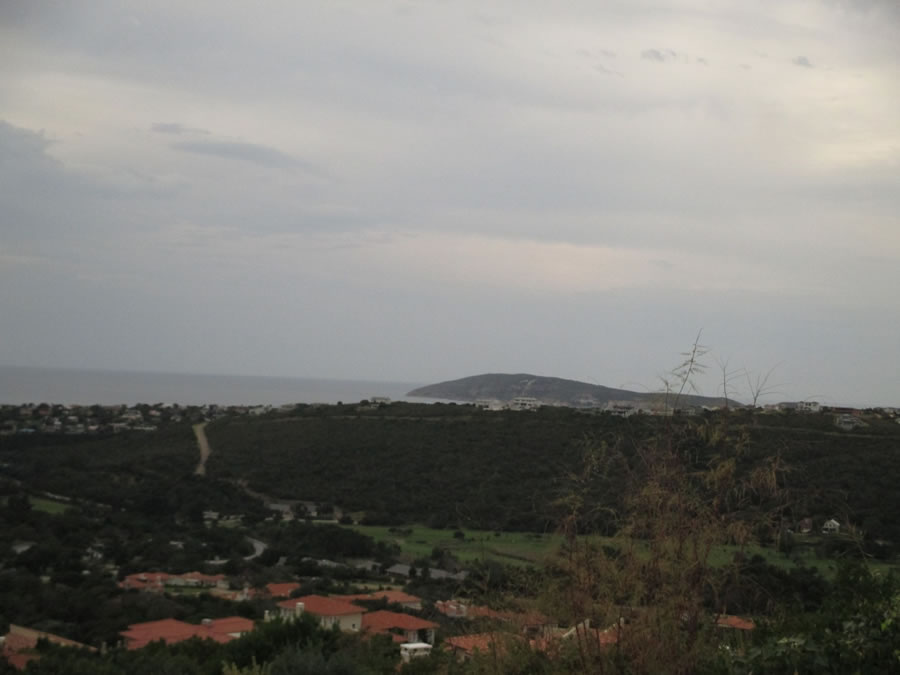
Piesang Valley today
The second school to be built was the Saint Andrews School in Redbourne, in the early 1950’s. Michael Francois Muller, born on 13th May 1920, and hailed from Mossel Bay, started that school, which was a primary school. It was also a “one man school”.
Michael Muller started his teaching career in Pella on the West Coast, then taught for a year at Kraaibosch in Knysna, and then started this school on his own. In 1957, he received his first assistant which was Monica Raubenheimer.
This school never had its own sports field. So in 1957, they were given a piece of land at Jackalskraal to use as a soccer field, seeing that Mr Muller was an avid soccer fan. And Mrs Raubenheimer remembers how generous the farmers and land owners in the area had been. Mr Van Rooyen, a farm owner nearby, where the Plett Country Club is now, gave the school a space for athletics and for a soccer field. And another nearby farm owner, Mr Jan Terblanche, gave space for a netball field. When Mr Muller retired, his position was taken over by his wife Gwen, who has run the school and served in that church at Saint Andrews for many years, before the school building was made a monastery, and at the moment the premises is a historic monument, where people from all over the globe rent the beautiful chapels for weddings.

Piesang Valley today
The third school in Piesang Valley was the NG Sending School, which served mainly coloured, Afrikaans speaking students. Monica Raubenheimer started that school in 1965 with a total of 35 students. It was also a “one man school”. Mrs Raubenheimer’s first assistant was Hetta Rose. In 1969, when the St. Peter’s Mission school moved to New Horizons and became Formosa Primary School, Monica Raubenheimer was transferred to Formosa Primary.
Mr Danie Arendse from Mossel Bay took over as principal. Then when Mr Arendse resigned, Mr Pierre Rose, who married Hetta Rose, took over as Principal in 1973. Thelma Paulse was also working at that school at that time, and at the end of 1973 that school was closed down. Thelma Paulse was the last person to close that school.
My father, Mac Dunn, was asked to help with the move of the NG Sending School to Formosa Primary, when the school was finally closed at the end of 1973. As a gift, for assisting with the move, he was given the original school bell. This bell is a historic heirloom, and therefore I cherish it, reminding me of the strong educational background that I have, and how my parents and my grandparents were involved in enhancing the educational development of our beautiful town for 3 generations starting in 1912.
This is our beautiful heritage. This is own pride. This is our beautiful town. This is Piesang Valley.
Thank you to Charmaine Wild for inviting me to share this small contribution towards this remarkable project of preserving the history of our beautiful town.
Leigh Dunn – June 3rd 2015